
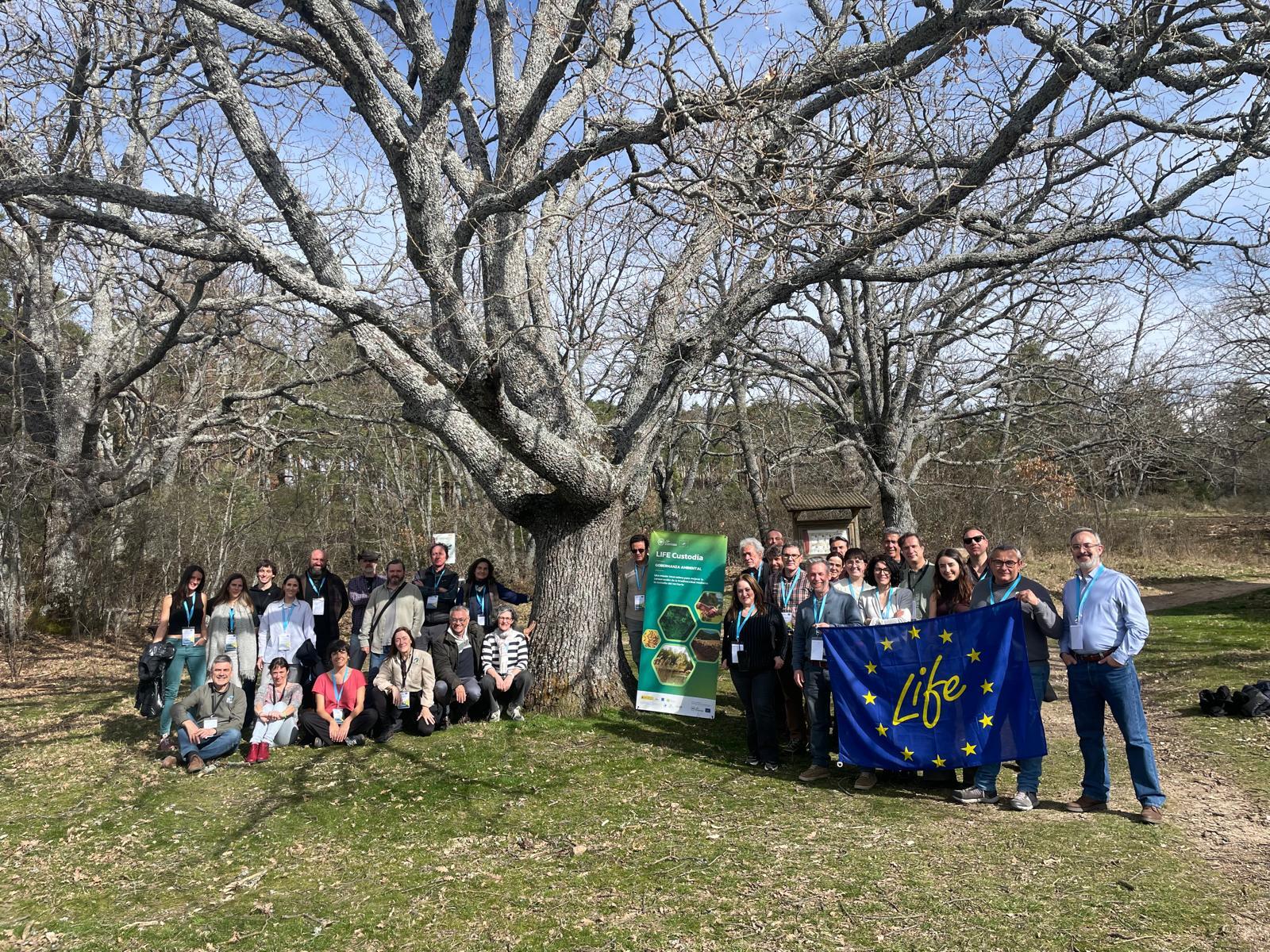
The LIFE Stewardship project is making progress in defining a proposal to promote land stewardship through public policies
The LIFE Stewardship project held a key meeting on February 24th and 25th, 2026, at the National Center for Environmental Education (CENEAM) in Valsaín (Segovia), as part of the policy advocacy work led by SEO/BirdLife. This initiative aims to foster collaboration with public administrations and other stakeholders to strengthen land stewardship as a governance tool for conservation. To this end, they developed an initial proposal of measures through a participatory process, culminating in this meeting.
The event brought together numerous representatives from public administrations at various levels—national, regional, and local—along with stewardship organizations, academics, and landowners. This diversity of profiles reinforces the multi-stakeholder nature of the process and allows for a comprehensive approach to integrating land stewardship into public policies.
Participants worked in four sectoral workshops—on riverine, forestry, agricultural, and urban areas—and a specific workshop on land ownership and stewardship. During the sessions, a draft proposal for integrating land stewardship into public policies was presented, conceived as a working document open to collective improvement. This process generated a significant volume of diagnoses, proposals, and recommendations that have been incorporated into the proposal. The meeting served as a collaborative workspace to foster dialogue between technical knowledge, management experience, and institutional perspectives.
The central objective of the meeting was to validate, strengthen, and strategically guide this proposal: comparing it with the results of the participatory process and ensuring its coherence with existing regulatory frameworks and sectoral policies.
This document is based on a shared structural diagnosis that identifies common barriers in different areas—river, forestry, agriculture, and urban—and proposes a set of measures organized into a cross-cutting block and four sectoral blocks. Key elements include the need to provide land stewardship with greater regulatory coherence, legal certainty, and administrative operability, as well as to bridge the gap between formal recognition and operational development in public policies.
A Cross-Cutting Tool for Territorial Governance
One of the most frequently repeated messages throughout the meeting was the need to move beyond a recognition that is still, in many cases, merely declarative, towards the effective integration of land stewardship into key instruments such as hydrological plans, forestry regulations, the Common Agricultural Policy, and municipal ordinances. In this context, land stewardship is reaffirmed as a cross-cutting tool for territorial governance, with the capacity to contribute operationally to objectives related to biodiversity, ecological restoration, and adaptation to climate change.
The work carried out in the different groups has allowed for the analysis and improvement of the proposal from a sectoral and cross-cutting perspective, identifying priorities such as the development of the regulatory framework, the creation of economic and fiscal incentives, the definition of monitoring, reporting, and verification systems, and the strengthening of capacity building and cultural change within public administrations. The importance of incorporating demonstrative examples and success stories as an advocacy tool was also highlighted.
The second day of the meeting focused on integrating the proposal into sectoral policies and defining a roadmap for its implementation. This work has allowed progress in prioritizing concrete actions and identifying strategic alliances, focusing on the role of public administrations, stewardship entities, landowners, the business sector, and other key actors in implementing the proposal.
In this regard, the meeting underscores the importance of strengthening public-social-private collaboration as the foundation for developing land stewardship, as well as the need to expand alliances to new sectors and adapt the language and tools to different territorial and institutional contexts.
With these sessions, the LIFE Sterwardship project has concluded a key phase of its participatory process and opened a new stage focused on policy advocacy and implementation. The resulting proposal of measures constitutes an intermediate step toward a consolidated document that will allow progress in the effective integration of land stewardship into public policies, contributing to its consolidation as a structural tool for conservation and sustainable land management.
LIFE STEWARDSHIP
The overall aim of the LIFE Stewardship project is to use land stewardship-based approaches to boost collaboration involving public and private entities as well as civil society for nature conservation and restoration in Spain, in the framework of the Europe Biodiversity Strategy 2030 and international agreements.
The project is coordinated by the Biodiversity Foundation of the Spanish Ministry of Ecological Transition and the Demographic Challenge, with the participation of Eurosite, the Forum of Land Stewardship Networks and Entities (FRECT), Global Nature Foundation (FGN), Fernando González Bernáldez/ Europarc-Spain Foundation, SEO/BirdLife and Nature Conservation Network (XCN) as partners. It has the financial contribution of the LIFE Programme of the European Union.