
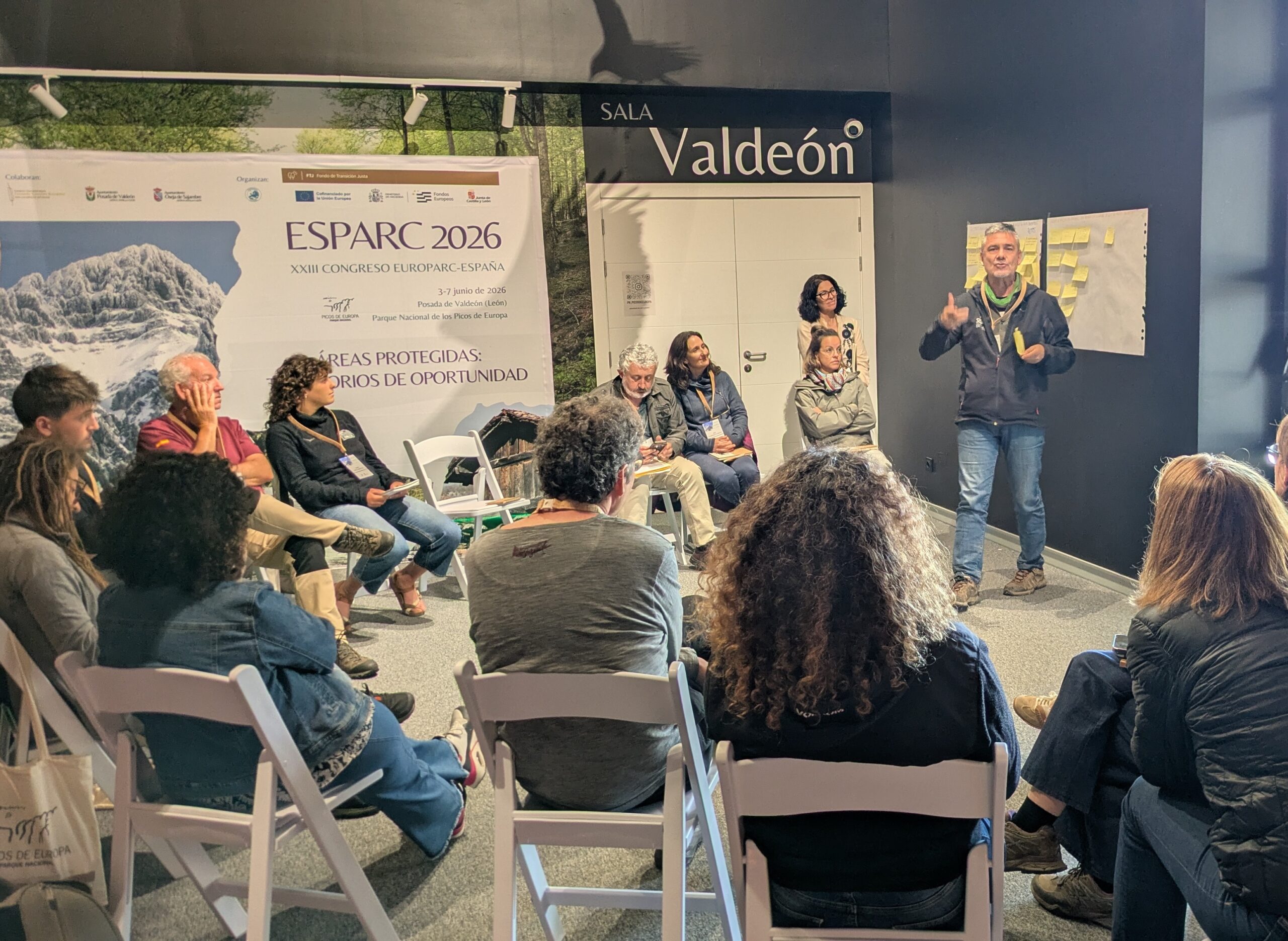
LIFE Stewardship organizes a workshop at the ESPARC 2026 Congress on land stewardship in protected natural areas
The LIFE Stewardship project coordinated a workshop entitled “Future Challenges of Land Stewardship as a Tool for Social Engagement in Conservation” in Posada de Valdeón (León) within the framework of the XXIII ESPARC 2026 Congress. This biennial congress is the main professional forum dedicated to the strategy and management of protected areas.
Specifically, the workshop served as a meeting place for the land stewardship community and the public administrations managing protected areas. Participants included representatives from land stewardship organizations, partners of the LIFE Stewardship project, and various national, local, and regional administrations managing protected areas.
During the meeting, updates on the LIFE Custodia project, the challenges of land stewardship in Spain, and successful collaborative experiences in protected areas such as in the Bay of Cádiz National Park, the Albufera de Valencia National Park, the Sierra Mariola National Park, and the Alto Tajo National Park, where shared.
Following these presentations, participants were invited to reflect on the key factors that make a collaborative stewardship experience in a protected area successful and on specific actions to be promoted by the EUROPARC-Spain forum in the coming years to foster stewardship in protected areas. These conclusions were presented at the closing plenary session of the ESPARC Congress.
For a stewardship initiative to be successful, respect, trust, and shared responsibility for the conservation of the areas among all parties involved—administration, organizations, landowners, and local communities—were highlighted as key factors. This is the starting point for creating alliances and real cooperation, with shared objectives and spaces for dialogue and collective work to ensure long-term conservation, according to workshop participants.
Keys to Land Stewardship in Protected Natural Areas
During the session, it was emphasized that stewardship organizations can bring flexibility and dynamism to the management of protected areas, reaching places or carrying out actions that are difficult for the public administration, but always tailored to each situation. All of this sometimes requires seeking out other similar experiences or thinking outside the box.
Thus, the conditions that lead to successful agreements were identified: long-term, manageable agreements, flexible regulations, registration of stewardship initiatives, rewards for those carried out, and searching for external funding.
Finally, concrete actions were decided to improve the effectiveness, involvement, coordination, and promotion of alliances for land stewardship within the EUROPARC-Spain framework. These actions include supporting protected area technicians in matters of land stewardship, promoting training and exchange activities (such as exchange forums, courses, and manuals), and disseminating information about land stewardship by sharing success stories and providing working and exchange opportunities at different levels.
The workshop was organized by the EUROPARC-Spain Technical Office and coordinated by the Land Stewardship Forum and the Biodiversity Foundation of the Ministry for Ecological Transition and the Demographic Challenge.
In addition to this workshop, land stewardship was addressed in other ESPARC events: a session of oral presentations dedicated exclusively to this topic, first in the forum’s history. Moreover, its relevance as a conservation tool in protected areas was also highlighted in the plenary session of the congress.
LIFE STEWARDSHIP
The overall aim of the LIFE Stewardship project is to use land stewardship-based approaches to boost collaboration involving public and private entities as well as civil society for nature conservation and restoration in Spain, in the framework of the Europe Biodiversity Strategy 2030 and international agreements.
The project is coordinated by the Biodiversity Foundation of the Spanish Ministry of Ecological Transition and the Demographic Challenge, with the participation of Eurosite, the Forum of Land Stewardship Networks and Entities (FRECT), Global Nature Foundation (FGN), Fernando González Bernáldez/ Europarc-Spain Foundation, SEO/BirdLife and Nature Conservation Network (XCN) as partners. It has the financial contribution of the LIFE Programme of the European Union.