
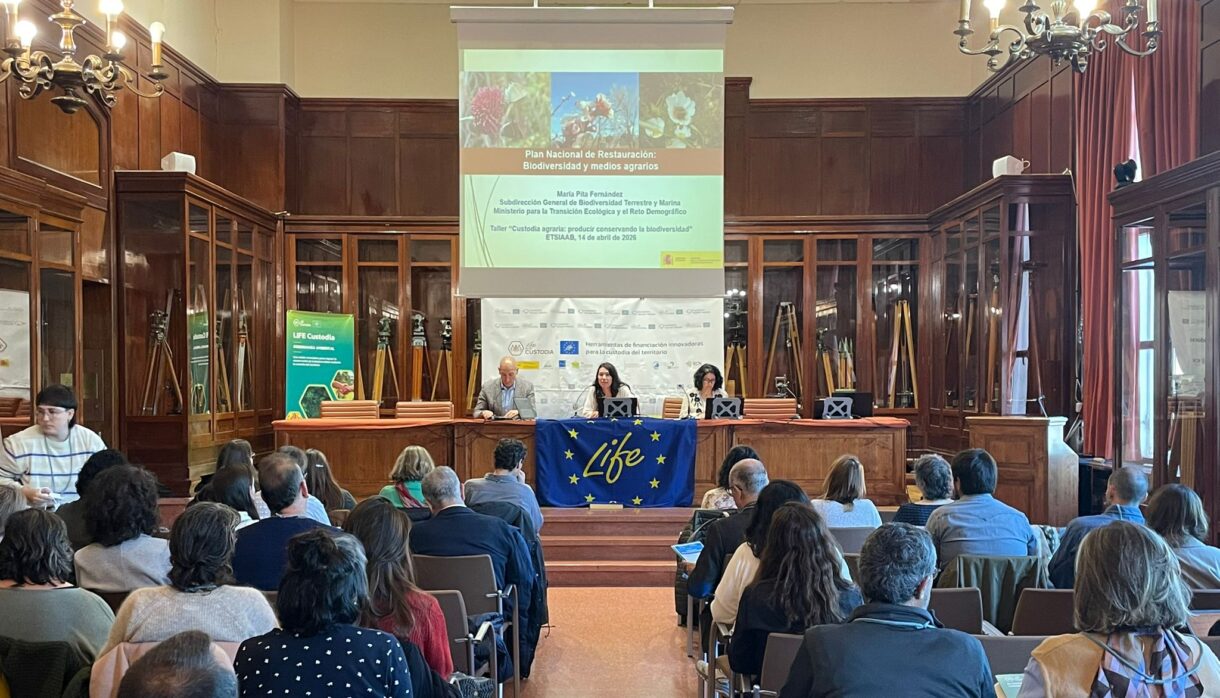
The third workshop on innovative financing addresses agrarian stewardship and biodiversity conservation
The LIFE Stewardship project has held a workshop focusing on the opportunities offered by land stewardship for nature conservation and restoration through voluntary stewardship agreements in the agri-food sector and on biodiversity metrics. In addition to the organisers and project partners, participants included the Sub-Directorate General for Terrestrial and Marine Biodiversity of MITECO, companies in the sector, and organisations seeking funding for their projects in agricultural settings. This is the third workshop dedicated to exploring alternatives for financing stewardship projects, organised by Fundación Global Nature (FGN), a project partner. The first workshop, held in Valencia in January, focused on projects related to water footprint offsetting, while the second workshop, held in Madrid in March, examined the role of compensation measures from renewable energy projects as a means of funding conservation and restoration initiatives implemented through land stewardship agreements.
The agricultural sector: key to biodiversity
According to the 7th inventory of land stewardship initiatives in Spain, 32% of land stewardship agreements are implemented on agricultural land. Among its main challenges, this sector faces the abandonment of extensive farming and livestock practices and a lack of generational renewal, while at the same time the adoption of an increasingly intensive agricultural model is growing. This combination of factors can transform landscapes, pollute soils, contribute to forest fires and reduce biodiversity.
Land stewardship is positioned as a tool with strong potential to link agricultural and livestock production with biodiversity gains, due to its ability to connect producers and landowners with stewardship organisations and other stakeholders. Furthermore, stewardship agreements are based on trust and technical support—both essential in a field as emerging as biodiversity metrics.
The concept of biodiversity net gain implies that any project or productive activity must not only offset the negative impacts it generates but also demonstrate a real and measurable improvement in the biodiversity of the area in which it operates.
During the conference, 17 conservation projects involving land stewardship in agrariansettings were presented, including a bat conservation project in agricultural and wine-growing ecosystems, as well as another project on habitat restoration through managed horse grazing, among others.
The event concluded with a discussion focused on the challenges of refining monitoring indicators and, in particular, on the rigorous measurement of biodiversity net gain, one of the key indicators in the new European regulatory framework.
LIFE STEWARDSHIP
The overall aim of the LIFE Stewardship project is to use land stewardship-based approaches to boost collaboration involving public and private entities as well as civil society for nature conservation and restoration in Spain, in the framework of the Europe Biodiversity Strategy 2030 and international agreements.
The project is coordinated by the Biodiversity Foundation of the Spanish Ministry of Ecological Transition and the Demographic Challenge, with the participation of Eurosite, the Forum of Land Stewardship Networks and Entities (FRECT), Global Nature Foundation (FGN), Fernando González Bernáldez/ Europarc-Spain Foundation, SEO/BirdLife and Nature Conservation Network (XCN) as partners. It has the financial contribution of the LIFE Programme of the European Union.